Retirement has changed in recent years. For many people, it is no longer defined by stopping work entirely or settling permanently in one place. Instead, it increasingly involves flexibility, seasonal living, and making deliberate choices about where time is spent, particularly during the winter months.
Against this backdrop, retirement in the Algarve has become one of the most practical and consistent destinations in Europe for extended winter stays and retirement living. Not because it promises an idealised lifestyle, but because retirement in the Algarve delivers a combination of climate, infrastructure, healthcare, safety and cost of living that works in everyday terms.This is especially relevant for those looking to avoid long northern winters without committing immediately to a permanent relocation, while still testing whether retirement in the Algarve is the right long-term decision.
Climate that supports normal routines
Winter conditions in the Algarve are mild by European standards. Average daytime temperatures typically range between 15°C and 20°C, with a high number of sunny days even between December and February. While rainfall occurs, it tends to be intermittent rather than persistent.
The impact of this climate is practical rather than aesthetic. People remain active throughout winter, walking, running errands and spending time outdoors without major disruption. Homes require less heating than in colder regions, which contributes to lower utility costs and simpler daily living.For long-stay visitors and retirees considering retirement in the Algarve, this consistency allows routines to remain stable across the season.
Cost of living, food culture and everyday quality
Compared with Northern Europe, the Algarve offers a predictable cost structure for day-to-day living. Grocery prices remain moderate, particularly for fresh Mediterranean produce, fish and locally sourced goods. Weekly markets operate year-round, supplying seasonal fruit and vegetables, fresh fish, olive oil and regional products that form the basis of a balanced Mediterranean diet. Food culture plays a central role in daily life. Eating well is not an occasional indulgence but a regular habit, supported by simple, fresh ingredients and accessible local cafés and neighbourhood restaurants. Outside the high summer season, prices remain stable and daily expenses are easier to manage, reinforcing why Algarve retirement is often associated with a healthier and more balanced lifestyle.
Safety, administrative stability and air quality
Portugal consistently ranks among the safest countries in Europe. The Algarve benefits from this national context, combined with an established community of long-stay residents and retirees.
Outside the summer months, the region operates at a calmer pace. Public services function reliably, healthcare access is straightforward, and everyday life feels organised rather than pressured. Air quality is an increasingly relevant consideration for long stays. According to European air-quality monitoring based on fine particulate matter, Faro regularly ranks among the European cities with the cleanest air. These measurements place Faro well below average pollution levels for mid-sized European cities, a factor linked to respiratory health and overall quality of life. For many long-stay residents exploring retirement in Algarve, Portugal, this translates into easier outdoor activity throughout the year.
Language and ease of integration
One of the Algarve’s most practical advantages is linguistic accessibility. English is widely spoken across the region, particularly in healthcare, hospitality, retail, banking and municipal services. This extends well beyond tourist-facing roles, with many medical professionals, administrative staff and service providers operating comfortably in English.
French and German are also commonly spoken, reflecting decades of tourism and long-stay residents from across Europe. This multilingual environment significantly reduces everyday barriers for newcomers.While learning Portuguese is encouraged and appreciated, it is not essential for managing daily life. Long-stay visitors who do not speak Portuguese generally navigate healthcare, services and social interactions without difficulty, especially in urban and coastal areas. Importantly, retirement in the Algarve does not mean living in an isolated foreign enclave. International residents live alongside local communities, and day-to-day interactions tend to be welcoming and informal.
Long winter stays as a first step
Many people considering retirement abroad begin with extended winter stays rather than an immediate permanent move. Typical stays range from one to three months and are often repeated annually.
This approach allows individuals to experience daily life rather than a holiday version of the region. Winter offers a clearer picture of routines, quieter streets and a resident-focused rhythm, making it easier to assess whether retirement in the Algarve works in practice.
It also preserves flexibility. People can return to their home country during summer while gradually assessing whether longer-term plans make sense.
Choosing the right area
Although the Algarve is compact, it is not uniform. Choosing the right area for a long winter stay or retirement depends less on scenery and more on access to services, healthcare, transport and how each municipality functions outside the summer season.
The Algarve is relatively flat along the coast, which makes walking, cycling and day-to-day mobility easier, particularly as people age. In towns such as Faro, Tavira, Lagos or Quarteira, much of daily life can be managed on foot, especially during winter months. Shops, cafés, health centres and services are often within walking distance.
Public transport exists but is limited outside the main corridors. For many retirees, the most practical arrangement is to live in a walkable urban or coastal centre and use a car only occasionally, especially when planning retirement in Algarve, Portugal.
Administratively, Faro is the capital of the Algarve and hosts the region’s main public hospital, the University of the Algarve, central government services and Faro International Airport. Faro is less resort-oriented than other coastal towns but offers strong infrastructure and reliable access to healthcare and administration.
Loulé is another key administrative municipality, covering a large and diverse area that includes inland towns and coastal locations such as Vilamoura, Quarteira and Almancil. While the historic town of Loulé itself is inland, the municipality benefits from robust infrastructure, private healthcare facilities and year-round services along its coast.
Portimão is also an administrative municipality and one of the Algarve’s main urban centres. It combines city-scale services with proximity to the coast and hosts one of the region’s public hospitals, making it a practical base for extended stays.
Beyond administrative centres, several towns play a central role in everyday life. Lagos offers walkability, a strong resident population and easy access to beaches. Quarteira stands out for providing direct access to the beach from a sizeable town centre, with a seafront promenade, local markets and transport links that reduce reliance on a car. These factors often place these towns among the best places to retire in Algarve, Portugal.
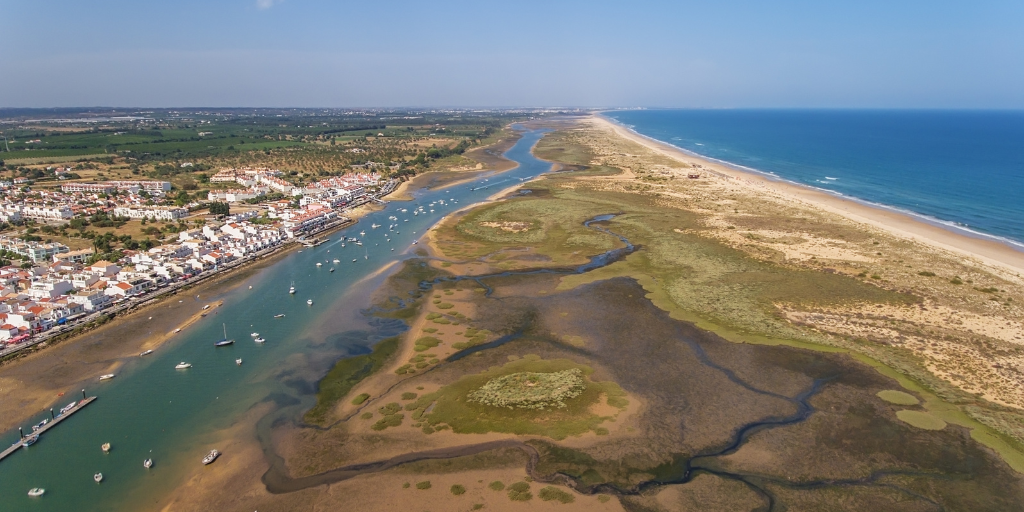
In the eastern Algarve, known as the Sotavento, towns such as Tavira and Vila Real de Santo António offer a quieter coastal environment, with access to barrier-island beaches, salt pans and river landscapes. This part of the region tends to appeal to those seeking a slower pace and a more traditional town structure and is frequently mentioned when discussing the best cities to retire in Portugal.
Inland areas, including the Serra de Monchique and Serra do Caldeirão, offer rural surroundings, lower housing density and cooler summer temperatures, but they require transport and longer travel times to hospitals and major services.
Healthcare access
Public hospitals are located in Faro, Portimão and Lagos, supported by a network of public health centres across the region. Private hospitals and clinics are concentrated around Faro, Loulé, Albufeira and Portimão, many offering English-speaking staff and specialist services.For those considering retirement in the Algarve, the question is not only whether it works today, but whether it will continue to work in 15 or 20 years’ time. The presence of hospitals, accessible services, stable communities and functional towns gives the region a clear advantage over destinations that are either too rural or overly dependent on seasonal tourism.
Connectivity beyond the region
Ease of travel remains important during retirement. Faro Airport offers regular direct connections to the United Kingdom, Ireland, France, Germany, the Netherlands and Nordic countries. While flight frequencies are lower in winter, routes remain stable, making it straightforward to travel back and forth without complex connections.This accessibility reduces the sense of distance and supports long stays, a factor often cited when comparing the Algarve with other destinations commonly listed among the best places to retire in the world.
A long-term decision, tested over time
For many people, retirement is no longer a single, irreversible move. It is a process, often shaped through long stays, repeated visits and gradual decisions rather than a clean break. In that sense, retirement in the Algarve lends itself particularly well to being tested over time.
It offers the practical conditions needed for daily life, access to healthcare, functional towns, stable communities and the ability to live independently without constant adjustments. It also allows people to remain connected to their country of origin while building a life that feels manageable and sustainable.
The more relevant question is not whether the Algarve sounds appealing, but whether it works once the novelty fades. For many who arrive for a winter stay and return year after year, the answer tends to come through daily routines rather than big decisions.