Ever pictured a walk in the Algarve where you might come across dinosaur footprints, hidden beaches, Roman remains and villages steeped in pirate stories? The Budens 5 Villages Route brings all of this together in two trails that show Algarve walking at its best, across the western Algarve, known locally as the Barlavento.
There is always something new to discover in the Algarve, even if you think you have already ticked off the best places to visit in the Algarve. A road you have never turned down, a beach that never makes the usual guidebooks, or a small village that turns out to be a pleasant surprise.
If you are looking for things to do in the Algarve beyond the best-known spots, the Budens 5 Villages Route (Rota das 5 Aldeias de Budens) is well worth considering. Officially opened in June 2025, it lies in the municipality of Vila do Bispo and adds two new routes for anyone keen on hiking in the Algarve. It links Budens, Figueira, Salema, Burgau and Vale de Boi via country lanes, coastal paths and quiet minor roads that cross some of the most beautiful scenery in this part of the region.
Along the way, you will find beaches tucked between cliffs, traces of old fishing communities and curiosities you would rarely stumble upon on a trip focused solely on the coast.
Two trails, plenty of reasons to explore
The Budens 5 Villages Route is made up of two circular trails. You can pick one, walk both on different days, or use the points of interest as inspiration for a road trip, stopping for short walks along the way.
Dinosaur Trail (PR8 VBP)
At around 10 km long, with an estimated walking time of 3 hours 10 minutes, this trail starts at the Fonte Milenar fountain in Budens and passes through Figueira and Salema.
It combines country lanes with a striking coastal stretch, taking in Praia da Figueira, the ruins of Forte de Vera Cruz and the clifftops leading to Salema.
The big surprise awaits on the beach: dinosaur footprints around 125 million years old, preserved in the rock right next to the sand.
Romans and Pirates Trail (PR7 VBP)
If you are after a longer walk, this circular trail covers around 14 km, with an estimated walking time of five hours.
It takes in places such as Boca do Rio, Praia das Cabanas Velhas and Burgau, with a link to Vale de Boi. It is a great opportunity to explore quieter beaches, take in the coastal scenery and discover places that fishermen, traders and seafarers were already visiting many centuries ago.
Both trails include paved sections and some uneven stretches, especially near the cliffs. Wear suitable footwear, take water with you and check the map before setting off.
Five villages, five good reasons to make the journey
If you are looking for things to do in the Algarve away from the busiest spots, each of these five villages gives you a different reason to stop. With little curiosities, beaches and local stories, there is plenty to discover along the way.
Budens
Budens is the starting point of the Dinosaur Trail and a village that rewards a short wander on foot.
Its streets are home to the Church of São Sebastião, old features linked to farming life and the intriguing Fonte Milenar, a water source used by generations of locals.
The fountain has one unusual detail: its large reddish stone trough still bears the marks left by people who sharpened their axes there. There is also a small heart in the stone. Finding it is part of the challenge the route itself sets visitors.
Another curiosity is the Moinho da Torre mill, which worked until 1958 and was later restored. It is a reminder of the days when mills were part of everyday farming life in this region.
Figueira
Figueira is a lovely surprise for anyone who likes to combine walking with lesser-known beaches.
From the village, you can walk down to Praia da Figueira, a beach framed by cliffs and reached by a footpath. Nearby stand the ruins of Forte de Vera Cruz, with views along the coast.
But Figueira’s greatest curiosity is a local tale that could have come straight out of an adventure novel.
The story goes that in May 1670, a group of North African pirates landed on the beach and tried to attack the village. The locals joined forces and managed to defeat the invaders.
Today, looking out over the little bay, it is hard to imagine such a scene.
Salema
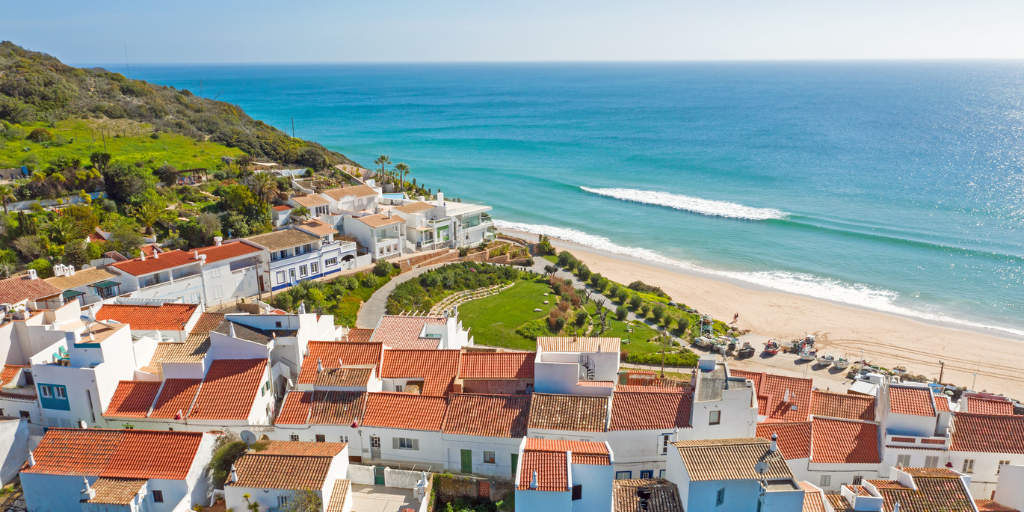
Salema is one of the best-known fishing villages in this part of the Algarve. Its houses tumble down the hillside to the beach, where you can still see fishing boats and a little of the activity that has always revolved around the catch.
The village takes its name from the salema, a fish found in these waters.
But what makes this beach truly special is hidden in plain sight.
At the western end of the beach, near the foot of the steps leading down to the sand, you will find the footprints of a plant-eating dinosaur that passed this way around 125 million years ago.
Don’t expect perfectly formed prints in the sand. They are imprinted on a limestone slab and can be hard to make out at first glance. The tide also affects whether you can see them, so check the tide times before you go.
Once you have found them, take a stroll through the village streets or stay on for lunch by the sea.
Burgau
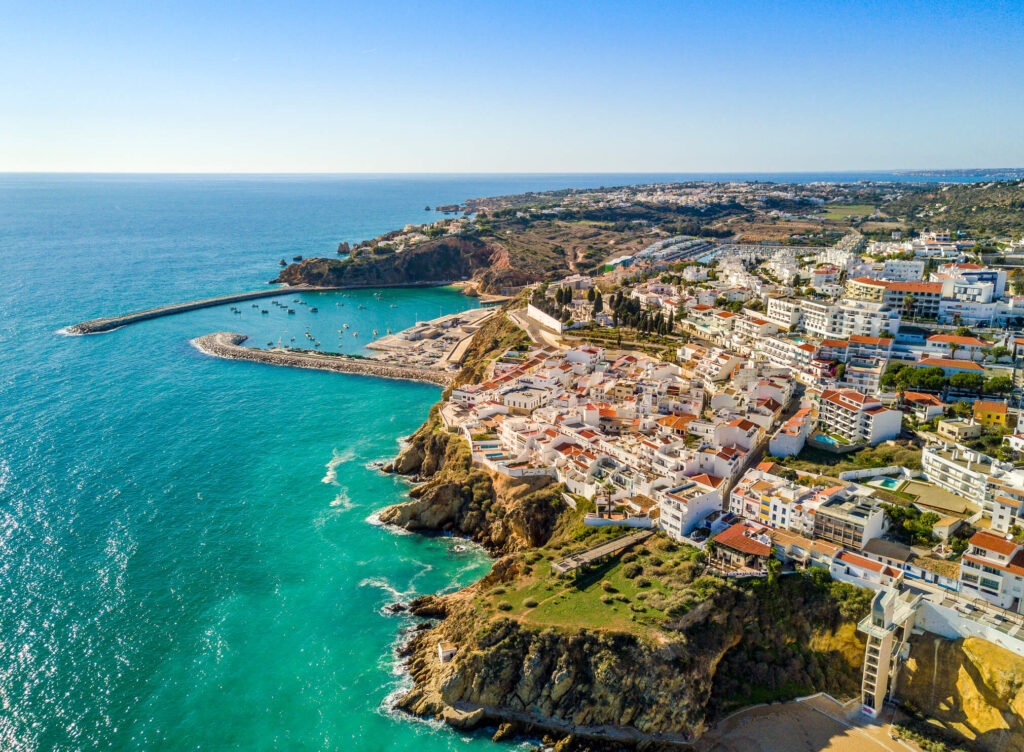
In Burgau, narrow, steep streets lead down to the beach, past whitewashed houses, small shops and corners with views over the Atlantic.
It is a particularly pleasant village to explore on foot, although some of the climbs may take a little extra effort.
Burgau grew up around a tuna fishing station in the 16th century. And its name hides a curiosity: it is linked to a small sea snail found on the rocks in the area, and locally the word is also used for smooth, rounded pebbles.
On the beach, look out for traces of the village’s fishing past, then take in the view from the higher parts of the village.
If the walk has worked up an appetite, Burgau is also a good place to stop for a bite at one of the seafront restaurants.
Vale de Boi
Vale de Boi lies inland, with scenery quite different from the coastal villages. For anyone drawn to the Algarve countryside, this small village surrounded by fields offers a glimpse of an area where farming and village life still shape the landscape.
But what makes Vale de Boi truly special is an extraordinary archaeological discovery: on a nearby hillside, traces of human occupation dating back at least 33,000 years have been found.
During excavations, researchers identified the remains of animals such as lions, bears and aurochs, as well as objects used by prehistoric communities.
Among the finds is a small schist plaque engraved with the figure of an aurochs.
Although the archaeological site is not a conventional museum attraction, the village reveals a very different side of the Algarve. While you are there, look out for the Ermida de São Lourenço, a small 17th-century chapel.
Along the way, don’t miss Boca do Rio
Of all the stops along the route, Boca do Rio deserves special attention.
The beach lies in an area of great natural interest, next to a wetland known as Paul da Lontreira. It is a particularly rewarding spot for birdwatching and for exploring landscapes where the countryside meets the sea.
And here is something few visitors would guess: around 2,000 years ago, Boca do Rio was home to a Roman port.
Archaeological excavations have uncovered the remains of an ancient settlement devoted to harvesting the sea’s resources, including Roman baths, mosaics and a quay around 40 metres long.
Nearby are the ruins of Forte de São Luís de Almádena, built in the 17th century to protect the tuna fishery.
For a shorter walk, the Boca do Rio Biodiversity Station (Estação da Biodiversidade) offers a circular trail of around 2 km, with views over the coast and the wetland.
A different way to spend a day in the Algarve
If you enjoy walking, exploring small places and discovering beaches off the beaten track, this route deserves a spot on your list of the best things to do in the Algarve.
There is no need to walk dozens of kilometres to make the most of your visit. You can choose just a few villages, pair a walk with lunch by the sea, or spend a whole day discovering this part of the western Algarve.
And if you are wondering about things to do in the Algarve with kids, you can tailor the visit to the children’s ages. Hunting for the heart carved into the Fonte Milenar or trying to spot the dinosaur footprints at Salema are two ideas for a family adventure. Just bear in mind access to the footprints and the tides, and avoid the more demanding coastal stretches with young children.
If you are planning a winter Algarve break, or any trip outside the summer months, the mild days of autumn, winter and spring make these paths especially enjoyable to explore.
Before you go, visit the official Budens 5 Villages Route website, where you will find maps, trail information and GPS files.